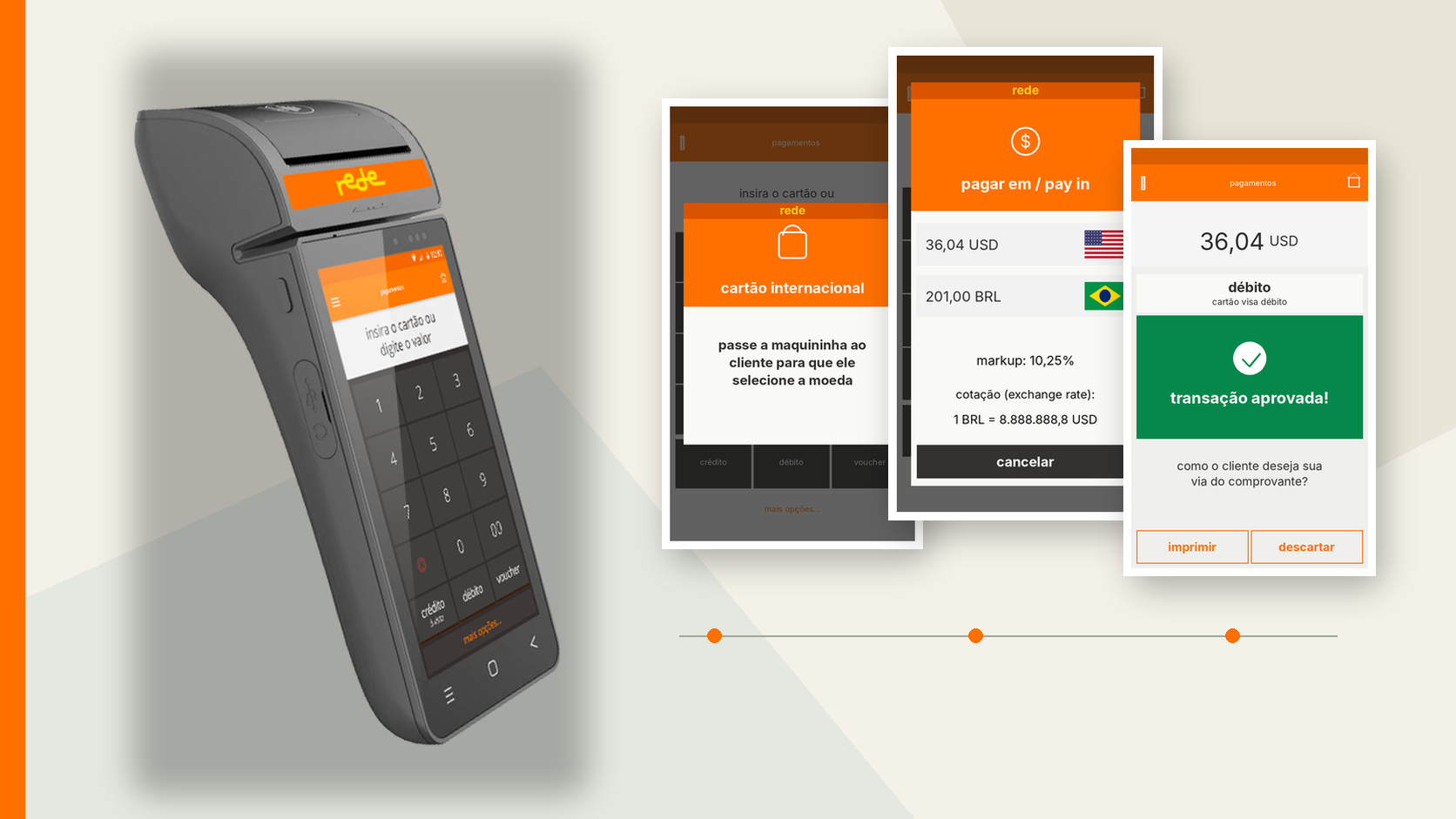
REDE DCC 1.0
Designing clarity across a multi-state payment journey
Interaction Design for a Dynamic Currency Conversion experience that helped international cardholders make a clear currency choice during an active payment transaction.
- Role
- Senior Product Designer
- Client
- REDE
- Company
- Môre Talent Tech
- Domain
- Payments / Dynamic Currency Conversion
- Year
- 2023
- Engagement
- 8 months
- Languages
- Portuguese / English
- Deliverable
- End-to-end transaction journey
- Status
- Implemented in REDE's product
International payments at the terminal
During the final eight months of my time at Môre Talent Tech, I worked with REDE on digital payment experiences. One of the initiatives was a Dynamic Currency Conversion service for international Mastercard and Visa cardholders using REDE payment terminals in Brazil.
The focus was to make a financial choice understandable inside a live transaction flow.
Making a financial choice clear inside a high-stakes transaction
International cardholders needed to decide whether to complete a purchase in BRL or in their home currency while already inside an active payment flow.
The experience needed to communicate that decision clearly across Portuguese and English while remaining coherent through multiple transactional states, including processing, authorization, errors, approval and decline.
End-to-end interaction design
As Senior Product Designer, I structured the end-to-end journey, interaction flows and interfaces for the DCC experience, prioritizing clarity, safety and ease of use.
I worked within a multidisciplinary squad, using REDE's existing Design System while designing and documenting additional components required by the new journey.
Designing for international cardholders
The experience was designed for international cardholders using cards linked to foreign accounts.
The interaction language had to remain legible at terminal speed.
Designing across Portuguese and English
Language was part of the transaction design itself. The experience needed to remain understandable for international cardholders while preserving the same decision structure, hierarchy and transactional feedback across Portuguese and English.
Consistency between languages protected both clarity and confidence during payment.
Orchestrating the transaction states
What appeared to be a simple currency choice unfolded across a complete payment journey: currency selection, conversion information, PIN entry, processing, authorization, approval or decline, errors and receipt states.
Clarity before progression
Each state needed to communicate what was happening, what decision was required and what the user should expect next without disrupting the speed of a payment-terminal interaction.
Knowing when not to prototype
A navigable prototype was not necessary for this delivery. The interaction model could be sufficiently reviewed through the structured transaction states, final interfaces and stakeholder review.
Avoiding unnecessary prototyping kept the work focused on the artifacts required to move the journey toward implementation.
Reviewing the complete transaction journey
The proposed experience, states and interfaces were presented and reviewed with stakeholders before delivery, allowing the complete transaction sequence to be evaluated as a coherent system rather than as isolated screens.
Stakeholder review confirmed continuity across the full payment sequence.
From interaction states to the final product
The DCC journey was documented and delivered for implementation in REDE's product, including the required transaction states, interface behavior and supporting components.
Delivery covered both journey integrity and implementation-facing specification detail.
A complete journey for a new payment capability
The work transformed a new currency-conversion requirement into a structured, bilingual payment journey covering the complete interaction from currency choice through transaction completion.
The result was a reviewed and documented experience implemented within REDE's existing payment ecosystem.
Designing the moments between decisions
Payment experiences are not defined only by their main action. Processing, waiting, errors, authorization and confirmation are equally important parts of the experience.
DCC reinforced the importance of designing transactional states as one continuous system rather than a collection of individual screens.